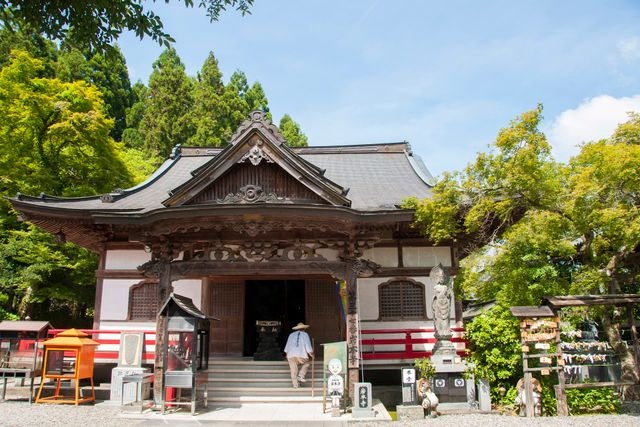
Iwamoto-ji Temple is a Shingon sect temple located in Shimanto-cho, Takaoka-gun, Kochi Prefecture. It's the 37th temple on the Shikoku Pilgrimage, renowned for its long history and tradition, said to have been established by Gyoki at the behest of Emperor Shomu.
According to temple records, its founding dates back to the Tempyo period (729-749 AD), when Gyoki, commissioned by Emperor Shomu, established the temple to pray for the eradication of seven misfortunes and the attainment of seven blessings. Originally located about 2 km northwest of its present site on the banks of the Niida River, it was known as "Niida Shichifuku" (Seven Blessings of Niida) or "Shichifuku-ji" (Seven Blessings Temple), due to the presence of Niida Myojin Shrine. Later, during the Koin period (810-824 AD), Kukai (Kobo Daishi) added Fukuenman-ji Temple, comprising five shrines and five temples. Each building housed a principal deity: Fudo Myoo in the East, Kiyomizu Kannon in the present location, Amida Nyorai in the central building, Yakushi Nyorai in the West, and Jizo Bosatsu in the sacred building. He is said to have practiced the secret Homa ritual. Thus, it came to be known as "Niida Gosa Jyuunifu-ji" (Niida Five Shrines and Twelve Blessings Temples), prospering as a temple under the patronage of Emperor Saga, with Fukuenman-ji serving as the head temple.
Although destroyed by fire during the Tensho period (1573-1592), it was subsequently restored by Sonkai Shinno, the lord of Ashizuri-yama, who commissioned his disciple Sonshin. Iwamoto-ji, on the other hand, was a lodging temple on the way to Ashizuri from Fukuenman-ji, located in town. In the late Middle Ages, Sonkai Shinno stayed there, giving the lodging the name Iwamoto-bo, which then flourished. Between 1652 and 1688, the head temple position transferred from the declining Fukuenman-ji to Iwamoto-ji, which was then renamed. The sutra copy would be inscribed as "Gosa Daimyojin Betto Iwamoto-ji".
With the separation of Shinto and Buddhism in the early Meiji period, the five Buddhist statues of Niida Gosa were moved to Iwamoto-ji. However, Iwamoto-ji was closed down in 1871 due to Kochi Prefecture's policy. It was then revived in 1889 and continues to this day.
The highlight of Iwamoto-ji is undoubtedly the 575 ceiling paintings in the main hall's inner sanctuary. Painted by various artists and ordinary citizens, these diverse paintings depicting flowers, birds, landscapes, and historical figures, will surely delight visitors. The temple also has lodging facilities, allowing visitors to experience the serene atmosphere of the temple while staying overnight. Why not spend some peaceful time at Iwamoto-ji, nestled in a quiet mountain village, immersing yourself in its rich history and culture?
 Favorite